

As experts try to understand the health effects of the Coronavirus, no one can deny the hit the economy has taken. In an April 29th article, Rueters reported the U.S. economy contracted in the first quarter in 2020 at its sharpest pace since the Great Recession. As stringent measures were taken to slow the spread of the Coronavirus and the country shut down, the longest economic expansion in the nation’s history was brought to a halt. Facility directors are faced with unprecedented budget obstacles.
Tax dollars that run into local, state and federal coffers will be falling short this fall with detrimental effects on budget plans. How long the effects will last and how deep the cuts will go is unclear, but we’re already starting to see the effects in both the public and private sectors.
Facility directors are starting to feel the pinch – having to make tough choices and cuts to meet demands. The discretionary spend is one of the only viable sources for reductions. What’s completely broken will need be replaced. Compliance measures must be met, so cuts to the discretionary spend, i.e. preventative maintenance, is the low hanging fruit.
We know, however, that this idea is counter intuitive. Just like the famous old commercial with the two auto mechanics said, “you can pay me now or pay him later.” The not so subtle message here being that you can either pay for the inexpensive oil & filter change now, or put it off and pay for an expensive engine repair in the future.
The answer isn’t funding requests based on anecdotes, opinions or last year’s leftover project list. Facility directors must make a case with irrefutable, engineered data that will bolster their cause with a solid financial plan.
What if you could show your finance team that every $1 that they cut from your discretionary budget now will result in an additional $25 requirement price next year or $50 just two years from now? Life expectancies shorten, deferred repair and replacement costs rise, and the chaos perpetuates itself.
What is Triage?
The first step is triage. Triage is a French word meaning “sorting.” In facilities management, triage (FM-Triage) identifies and ranks projects that should be funded before others as well as projects that should receive little or no funding (abandonment). This process also has ethical implications, since abandonment would be contrary to the principles of stewardship. Two key metrics used as the basis for a credible FM-Triage are the Mission Dependency Index (MDI) and the Condition Index (CI). For comparing multiple building systems within a single budget analysis, the solution should include an additional ranking metric. The System Criticality Index (SCI) establishes the ranking hierarchy from most critical to least critical building systems, i.e. Life-Safety Systems/HVAC/Roofs most critical and carpet least critical. In simple terms:

If the budget ax must fall, this triaged ranking process might soften the blow to your department’s budget. A plan that focuses on what can be saved at lower costs with a programmatic approach, can show cause for repairing something today to extend life and ultimately lowering total cost of ownership of assets.
Run to Failure
The graph below illustrates this common sense approach. Less expensive repairs done today extend life and reduce overall spend while monies spent on run to failure models prove much more costly. The black line is the current life cycle deterioration curve of the asset. The red line is the point at which repair investments are wasted, because the asset has reached the point of failure. The sweet spot is the small gap where repairs and improvements can be done inexpensively and effectively that push the green line (extended life cycle) out.
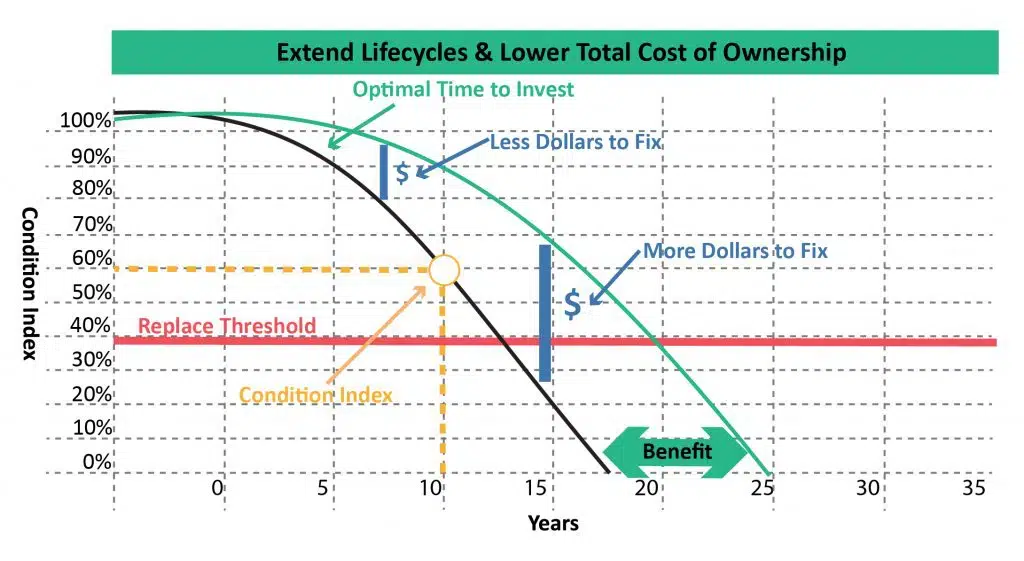
As a facility director, having an analytical plan could help you win funding by flipping the script. It starts with making the move to thinking programmatically. Get smart with your deferred backlog and triage it now. It will help you in the budget battle by providing facilities financial decision makers with an empirical and scientific methodology to understand and weigh both the benefits and consequences associated with constrained budgets.
What’s next for your building envelope?
Contact us today to learn more about how ON-PNT® can support your facility goals year-round.